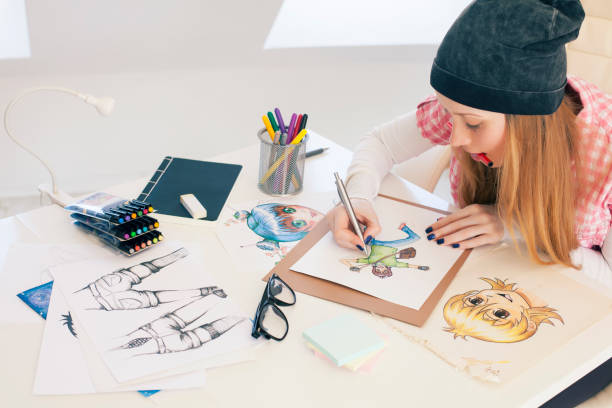

how to draw anime face
You may create expressive figures with personality and emotion by learning to draw anime faces, which is a fun and gratifying talent. Large eyes, distinctive facial features, and exaggerated expressions are characteristics of anime characters. This detailed tutorial will take you through the entire process of drawing a simple anime face, from creating the outline to adding the finishing touches, regardless of your level of experience.
1. Begin with a simple shape.
Start by sketching the face’s contour. The majority of anime faces are depicted with a straightforward oval or circular head shape. The remainder of the face is built upon this. You might want to change the contour a little bit, depending on how old the character is. While older characters usually have more angular or heart-shaped faces, younger characters or children may have rounder, softer faces. To assist balance the symmetry, draw a vertical line down the middle of the face. Later, place the eyes in the middle of the circle by drawing a horizontal line across it.
2. Position the Face Features
It’s time to start arranging the facial features after you have the basic shape. The eyes, which are the main feature of the majority of anime faces, should come first. Along the horizontal line, draw two sizable almond or oval shapes, leaving some space between them. Anime eyes usually take up a substantial amount of the face and are much bigger than actual human eyes. Depending on the character’s characteristics, feel free to enhance the size or colour of the iris and pupil inside each eye. Remember that anime eyes frequently portray intense emotions, so you can change the eyes’ shape to fit the scene: round and wide for excitement, narrow for intensity, or soft and droopy for grief.
Next, draw the lips and nose. In anime, the nose is typically quite small, sometimes appearing as a single line or tiny dot beneath the eyes. A simple line or slight curve works nicely for a more defined nose. Usually a narrow, curving line, the mouth’s form can represent a variety of emotions. A smile is indicated by an upturned line, although a soft curve may convey contentment or happiness. The mouth should be positioned just below the nose, typically in the middle of the face’s vertical line.
3. Include the Ears and Eyebrows
In anime, eyebrows are typically strong and expressive. Use softer, curving lines for a kinder expression or thicker, angular lines for a more dramatic effect when drawing them just above the eyes. Since eyebrows are essential for expressing emotions, modify them to fit the mood of your character. For example, furious eyebrows would have sharp angles, but those of a happy or startled person will be more relaxed.
The ears should then be drawn, roughly aligned with the eyes, on either side of the head. Simple, low-detail anime ears are OK as long as they match the face. You can include the ear’s interior features for a more intricate appearance. As is typical of many anime styles, you can keep the ears simpler if you’d rather take a more stylised approach.
4. Sketch the Hair
One of the most imaginative and thrilling aspects of designing a character’s face is frequently their anime hair. Determine the length, form, and style of the hair by first drawing its broad contour. You can create long, flowing hair for a softer character or short, spiky hair for a more energetic appearance. Feel free to experiment with dramatic volume, pointed spikes, or sophisticated waves because anime hair frequently violates the laws of physics.
To enhance texture, apply individual strands or layers while paying attention to the direction the hair flows. Make sure to apply these around the forehead area because anime characters frequently have big, dramatic fringes or fringe. Longer hairstyles could have softer, gentler curves, but shorter haircuts should have crisp, angular lines. Anime characters are known for their hair, so take use of this to showcase your character’s individuality and sense of style.
5. Enhance the Features and Face
Now that you’ve established the fundamental hairstyle and facial features, it’s time to add the finishing touches. Review your opening lines and revise as necessary. This could entail relaxing the jawline’s angles, enhancing the mouth’s curvature, or giving the eyes more expressiveness. Verify that the features are proportionate to the character’s face shape and well-balanced. Remove any extraneous building lines and concentrate on creating a smooth, polished face.
6. Include final touches and shading.
Your anime face will get depth and dimension through shading. Light shading should be applied first beneath the hairline, under the chin, and around the borders of the face. To add shadows to the face, particularly around the nose, beneath the eyes, and close to the mouth’s borders, use delicate lines or stippling. To make the eyes seem more natural, they should also be shaded, with lighter regions for highlights and darker parts surrounding the iris.
Use shading on the hair to imply texture and volume. Hair can appear more three-dimensional by being shaded in the regions where it overlaps and around the hairline. To increase contrast and make the face more lively, you can also apply highlights to places like the cheekbones or the top of the head where light would naturally fall.
7. In conclusion, perfection comes from practice.
It takes effort and practice to draw an anime face, but you will eventually find your own style and refine your skill. If your initial attempts aren’t flawless, don’t give up; keep practicing and try out various facial expressions, hairstyles, and facial shapes to create distinctive and captivating characters. As you keep improving, you’ll discover how to use the expressiveness and simplicity of anime faces to portray a variety of personalities and feelings. Have fun with your drawings!