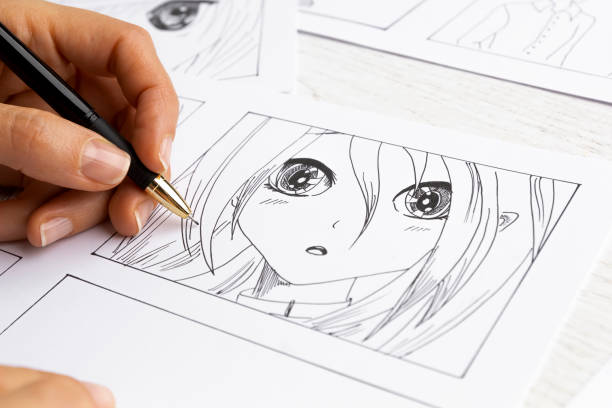

how to draw anime hair
One of the most enjoyable and imaginative aspects of character design is drawing anime hair. You can play with different forms, lengths, and styles of anime hair, which can range from smooth and beautiful to spiky and wild. If you want to learn how to draw anime hair, this tutorial will teach you the fundamentals of drawing expressive, dynamic hair that accentuates the individuality of your character. This article will offer pointers and methods to help you become a better anime hair-drawer, regardless of your level of experience.
1. Begin with the Fundamental Head Shape and Rules
It’s crucial to determine the character’s head form before drawing anime hair. Start by drawing a basic oval or circle for the head, then a vertical line down the middle of the face, and then a horizontal line for the location of the eyes. By following these tips, you can make sure that your hair is positioned correctly and is balanced on your head. Keep in mind that the character will determine the size and shape of the skull, but this basic rule will be your starting point.
Mark the beginning of the hairline after the head has been defined. You can change this for different styles; some anime characters have higher or lower hairlines. Generally, the hairline is just above the eyes. Remember that hair often begins at the crown of the head and cascades downward.
2. Arrange the General Shape and Hairstyle
Consider the general form and style of your character’s hair before getting into the specifics. Consider how your character’s hair will convey their personality and mood, as anime hair is frequently stylised and exaggerated. Are they vivacious, solemn, or laid back? It can be short and spiky, long and flowing, or even completely wild. Draw a loose outline of the hair, omitting the desired volume and overall contour.
Keep in mind that hair does not necessarily need to precisely match the head’s form. For instance, longer hair may fall softly around the face and shoulders, whereas spiky hair may protrude in various directions. The hair needs volume, so don’t put it too near to the scalp; instead, allow a little gap between the head and the hairline to indicate where the hair starts.
3. Sketch the Hair in Layers and Sections
To add depth and texture, anime hair is sometimes depicted in layers or parts. Instead of sketching each hair strand separately, separate the hair into larger groups or clusters. Concentrating on the general direction and flow of the hair, begin with the larger areas and work your way down. Long hair, for instance, may have a major portion that falls downward and smaller strands or sections that frame the face.
Draw each segment according to the hair’s natural flow. As it follows the natural curves of the skull, hair does not grow in completely straight lines. Consider the potential effects of movement and gravity on the hair’s shape, and add some curves to give it a more dynamic appearance. Sharp, angular shapes that imply motion and texture can be used to depict short or spiky hair.
4. Include Texture and Volume Details
It’s time to add texture and volume after you’ve determined the hair’s fundamental structure and flow. The hair seems vibrant and lifelike because of its texture. Within each larger hair chunk, begin by adding individual strands or smaller portions. Curved lines can be used to depict hair strands in lengthier hairstyles, while sharp, jagged lines can be used to produce points and spikes in hair that is spiky.
Draw strands that overlap or stack on top of each other to add volume. The top layers of hair in longer hairstyles, for instance, are frequently fuller and thicker, but the lower layers may be thinner or marginally less defined. you give your lines a sense of movement and organic flow, make sure you vary their direction enough.
5. Include Highlights and Shading
To make anime hair come to life, shading and highlights are essential. Use shading to create depth in places like beneath layers or close to the roots where the hair would naturally throw shadows. Softer, curved lines might be used for the shadowing to create a three-dimensional impression on the hair. When darkening your hair, pay attention to the light source. For instance, the upper layers of hair will be lighter and the hair nearer the neck will have more shadow if the light is coming from above.
Another crucial element is highlights, especially for hair that is sleek or glossy. You can either use lighter, softer lines to indicate where the light hits the hair or leave some parts of the hair undisturbed to produce highlights. These highlights can be applied to places that naturally reflect light, on the tips of the hair, or close to the top of the head.
6. Complete the drawing and polish the details.
It’s time to polish your drawing now that you’ve added lighting and shade. Review your lines and trim any sharp or uneven edges. To make the hair flow more natural, you might also want to remove or modify a few of the portions. To make your drawing more realistic, add any last-minute details, including wayward strands or finer textures.
Finally, inspect the hair’s overall proportions one last time. Make sure the hair matches the character’s face and that the volume appears balanced. To achieve a more unified image, if needed, change the hair’s angles and flow. Keep in mind that anime hair can be extremely stylised, so feel free to try out various styles and methods.
7. Conclusion: The Key Is Practice and Creativity
It takes practice to draw anime hair, but every try will help you get better at it. You’ll get better at capturing various hairstyles and using a character’s hair to convey their personality the more you practise. Whether your hair is thick, smooth, spiky, or messy, don’t be scared to experiment. You can produce beautiful, expressive anime hair and establish your own distinct style with time and effort. You’re only a few lines away from creating your next anime haircut, so pick up your pencil and get to work!