
how to draw anime
The unique artistic style of anime has influenced fans, illustrators, and artists all around the world, making it a global phenomenon. Enrolling in an anime drawing course will introduce you to a world of fun, creativity, and expression. This book will help you start sketching anime, from learning the fundamentals to honing your skills, regardless of whether you’re motivated by your favourite characters or simply want to experiment with a different artistic approach.
Since the majority of anime characters are based on human anatomy, albeit in a stylised form, the first step in drawing anime is to comprehend the fundamentals of human figure structure. Learn the human body’s proportions first, including the placement of the arms, legs, torso, and head. Getting the fundamentals correct will allow you adjust the proportions to fit your preferred style, as anime characters frequently have exaggerated features like huge heads, enormous eyes, and skinny bodies. To design a structure that resembles a skeleton, start by outlining the body with basic forms like circles for the head and torso and lines for the limbs.
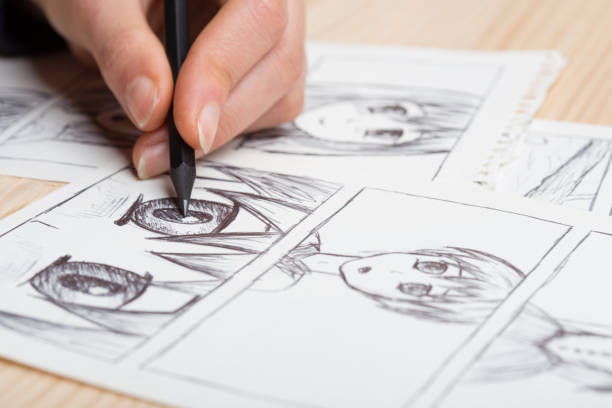
Concentrate on the head and face after you’re at ease with the fundamental proportions. One of the most recognisable features in anime is the face. Start with the head’s outline, which is often spherical or oval. Then, to assist you in positioning the features, draw a line across the face in both vertical and horizontal directions. In anime, the eyes usually take up a big amount of the face and are expressive and large. Focus on the shapes and placement of the pupils and eyelashes to learn how to draw various kinds of eyes. Usually depicted with only a few lines, the mouth and nose are small and simple, adding to the character’s overall attractiveness.
The next step is to add the hair after you have mastered the fundamental anatomy of the head and face. Exaggerated shapes and layers are common in anime hair, which is characterised by volume and movement. Taking into account the characteristics of the character and the desired look, begin by drawing the general contour of the hair. For instance, your character may appear more vivacious with spikey hair, or elegant with long, flowing hair. Draw the individual strands or spikes of hair by breaking it up into portions, constantly keeping in mind how the hair moves and interacts with the character’s head. Don’t be scared to try out different haircuts that will add personality to your character.
The next step is to provide elements that make your anime character come to life. This can include facial expressions, attire, and accessories. Consider how a character’s attire conveys their feelings and role, as clothing in anime frequently reflects a character’s personality. A combatant, for instance, may dress in armour or athletic attire, whereas a magical girl might wear a garment with intricate details and a whimsical feel. In a similar vein, the expression plays a vital role in expressing the character’s feelings. To convey emotions like happiness, sorrow, or resolve, use the mouth’s position, the eyebrows’ location, and the size and form of the eyes. Your character will have more depth and realism in the stylised anime environment thanks to these minor face feature adjustments.
Once your drawing is finished, it’s time to apply shading and polish the details. To define the character and eliminate extraneous guidelines, use crisp, accurate lines. To give your character depth, you can apply shading, particularly to the face, hair, and attire. In anime, shading is frequently employed to draw attention to the light source and accentuate the form of the character. For delicate highlights and shadows, use cross-hatching or smooth gradients. Your drawing will look more three-dimensional if you add a little shade along the sides of the hair or under the chin.
Colouring your anime figure is the last stage. Adding colour can make your character come to life, even if you decide to retain your drawing in black and white. Depending on whether you’re using a computer or tablet, you can utilise digital tools or more conventional tools like coloured pencils or markers. When colouring, think about how the character’s complexion, hair, and clothes will change depending on the lighting. Use highlights to give the character a more dynamic appearance and combine colours seamlessly for a polished appearance.
To sum up, learning to draw anime entails developing fundamental drawing techniques, honing facial expressions, and incorporating the distinctive stylistic features that give anime its distinctive identity. The secret is to study many anime styles, practise frequently, and enjoy creating your work, regardless of your level of experience. You will eventually establish your own style and method, which will enable you to create characters that are not just technically accurate but also vibrant and dynamic. Continue experimenting and relish the creative process of making your own anime universe!